See how we’re doing things differently.

The Wheeler River Project

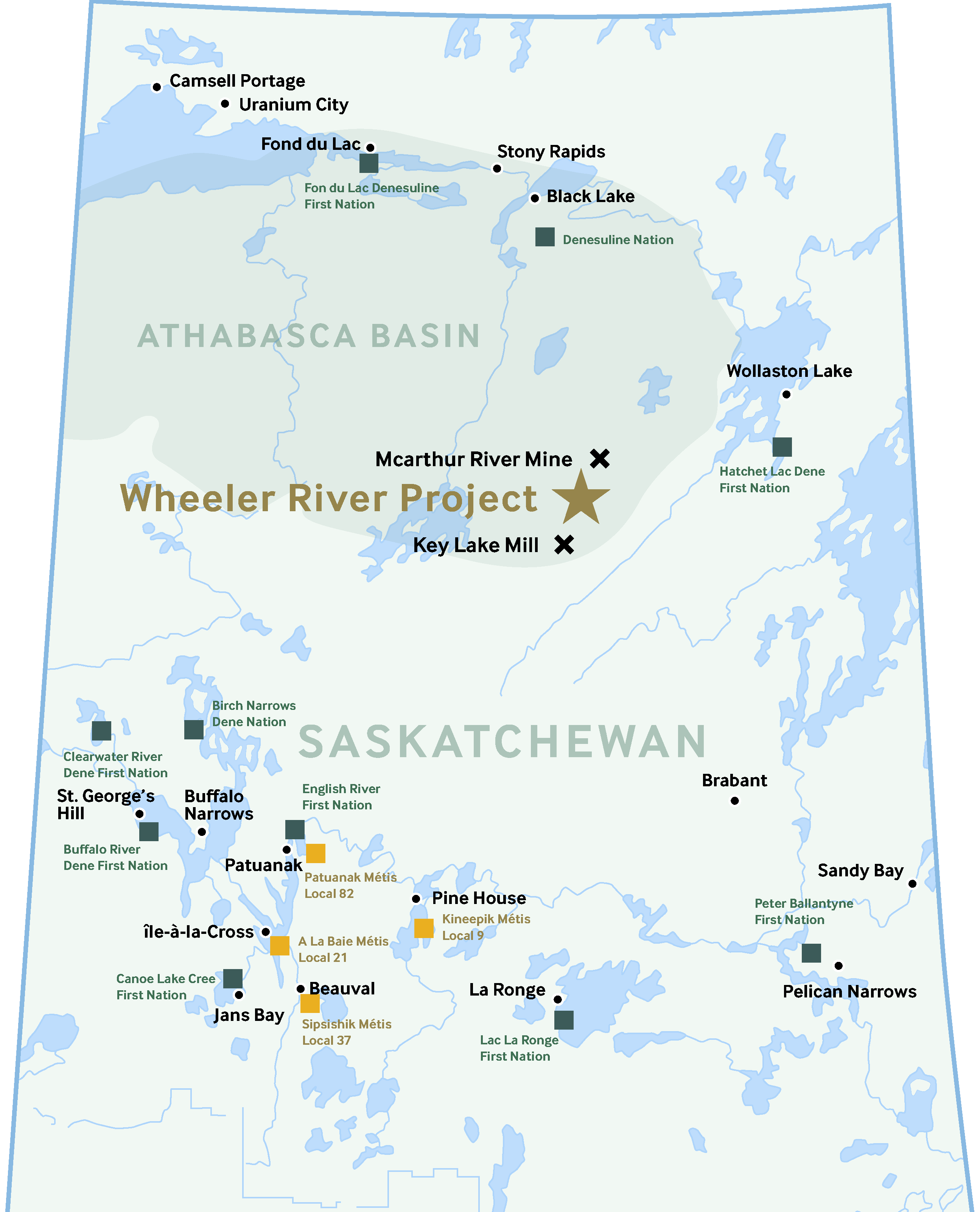
The Wheeler River Project is situated in the eastern portion of the Athabasca Basin region in northern Saskatchewan, and it is the site of a proposed In Situ Recovery (ISR) uranium mining project. It is located 35 km north-northeast of the Key Lake mill and 35 km southwest of the McArther River uranium mine, within the traditional territory of several Indigenous communities. Denison Mines holds an effective 95% ownership and operates the project with a deep commitment to collaboration—working closely with Indigenous groups and local communities to build a legacy of responsible development.
Access all current material associated to the Wheeler River Project’s Federal Environmental Assessment by clicking below.

Drilling down to learn what’s important to your communities.

There is more to our business than just mining uranium.  We recognize that we operate in a remote natural setting in northern Saskatchewan that is the traditional territory of multiple Indigenous nations and with multiple northern communities that have an interest in our activities. We strive to lead with responsibility and respect working to bring people and ideas together.

In situ recovery (ISR) mining is widely used outside of Canada, but the Wheeler River Project will mark the first time this method is used at a Canadian uranium mining site. With no conventional tailings, no large waste rock piles, and no open pits or major earthworks, ISR mining is progressive, economical, and environmentally responsible. And when the mining ends? The site will be restored in compliance with high environmental standards.

I’ve seen the future of mining with Denison.
Only it’s here & now.

Frequently asked questions.

What is ISR Mining?

In Situ Recovery (or ISR) is a method of mining an orebody in place. ISR uses an acidic mining solution, which is pumped through the orebody by injection and recovery wells to recover the mineral. No rock is excavated. Instead, the targeted mineral (in this case uranium) is dissolved in place as the mining solution travels from injection wells to recovery wells. The recovery wells bring the mining solution and dissolved uranium back to surface as part of the ISR mining process. The active ‘mining’ occurs below ground, no rock is excavated, and there is minimal impact to the surface landscape

ISR mining is a well-established uranium mining method, accounting for a significant portion of global annual uranium production from multiple operations in the United States, Australia, and Kazakhstan, amongst others.

Specific to the Phoenix deposit, a freeze wall is installed from surface to beyond the depth of the orebody to provide an extra layer of containment for the acidic mining solution to stay within the mining zone.

How will ISR mining at Phoenix impact water quality?

The impact to water quality is expected to be minimal – this has been predicted through the completion of a comprehensive environmental assessment process that is subject to both Federal and Provincial regulatory oversight. ISR mining at Phoenix occurs 400 metres below surface; the data collected from the area indicates the rate that water from the orebody migrates to surface is incredibly slow (less than 1 metre per 1 year). This means that the risk of migration to surface lakes is very low and would only occur after the mining area is remediated and the freeze wall removed.   

The freeze wall will be in place during operation and will surround the mining zone as a supplemental environmental control. Within this freeze wall, fluid flows are highly controlled to ensure containment and recovery of the dissolved uranium. The characteristics  of ISR mining allow Denison to recycle water used in mining – the amount of water used, water treated, and water released to the environment during operations are anticipated to be much lower than other northern Saskatchewan mine sites. Regardless, all site water will be tested and when required, treated to meet regulatory requirements, to ensure the downstream environment remains protected.

Why is In Situ Recovery (ISR) only now being introduced in Canada?

ISR mining has gained in prominence in the global uranium sector in the last 20 years with the development of multiple uranium mines in Kazakhstan, Australia, and the United States. When Cigar Lake and McArthur were developed in Saskatchewan, ISR mining was less common and was not considered applicable to the Athabasca Basin. Since then, advancements in ISR and ground freezing technology have allowed Denison to design an ISR mine that is suitable for certain deposits in the Athabasca Basin.

What legacy will Denison leave behind for the people of northern Saskatchewan?

The people and Indigenous nations of northern Saskatchewan have clear ideas of how they want to work with the next generation of uranium mining operations; determining what kind of positive legacy Denison will have within the north must be determined by the people of northern Saskatchewan and Denison together.

When will construction and mining start?

Before construction can begin, we first must complete the permitting and licensing process. We anticipate receipt of the final regulatory approvals to permit the commencement of construction in the first half of 2026.  Construction is expected to last for approximately 2 years, and the site is expected to be in operation for approximately 10 years. Closure and reclamation procedures will last for approximately 8 years after completion of operations.

How is the mining solution contained?

Denison has a defense-in-depth containment strategy to ensure groundwater and the environment are protected. This multi-layered containment approach includes injection and recovery wells that are pressure-grouted and integrity-tested. Wells have an inward hydraulic gradient to ensure controlled flow toward recovery wells. The freeze wall provides an additional layer of containment, and containment is verified by the monitoring network. The CNSC and the Saskatchewan Ministry of Environment have confirmed that the wellfield containment plan meets regulatory requirements.

Connect with us.

We’re here to continue the conversation—about the Wheeler River Project, our partnerships, and our future together. Reach out anytime.

11 + 9 =